平衡二叉树(Balanced Binary Tree)
具有以下性质:
它是一棵空树或它的左右两个子树的高度差的绝对值不超过1,并且左右两个子树都是一棵平衡二叉树。
平衡二叉树的常用实现方法有红黑树、AVL、替罪羊树、Treap、伸展树等。
最小二叉平衡树的节点的公式如下 F(n)=F(n-1)+F(n-2)+1 这个类似于一个递归的数列,可以参考Fibonacci数列,1是根节点,F(n-1)是左子树的节点数量,F(n-2)是右子树的节点数量。
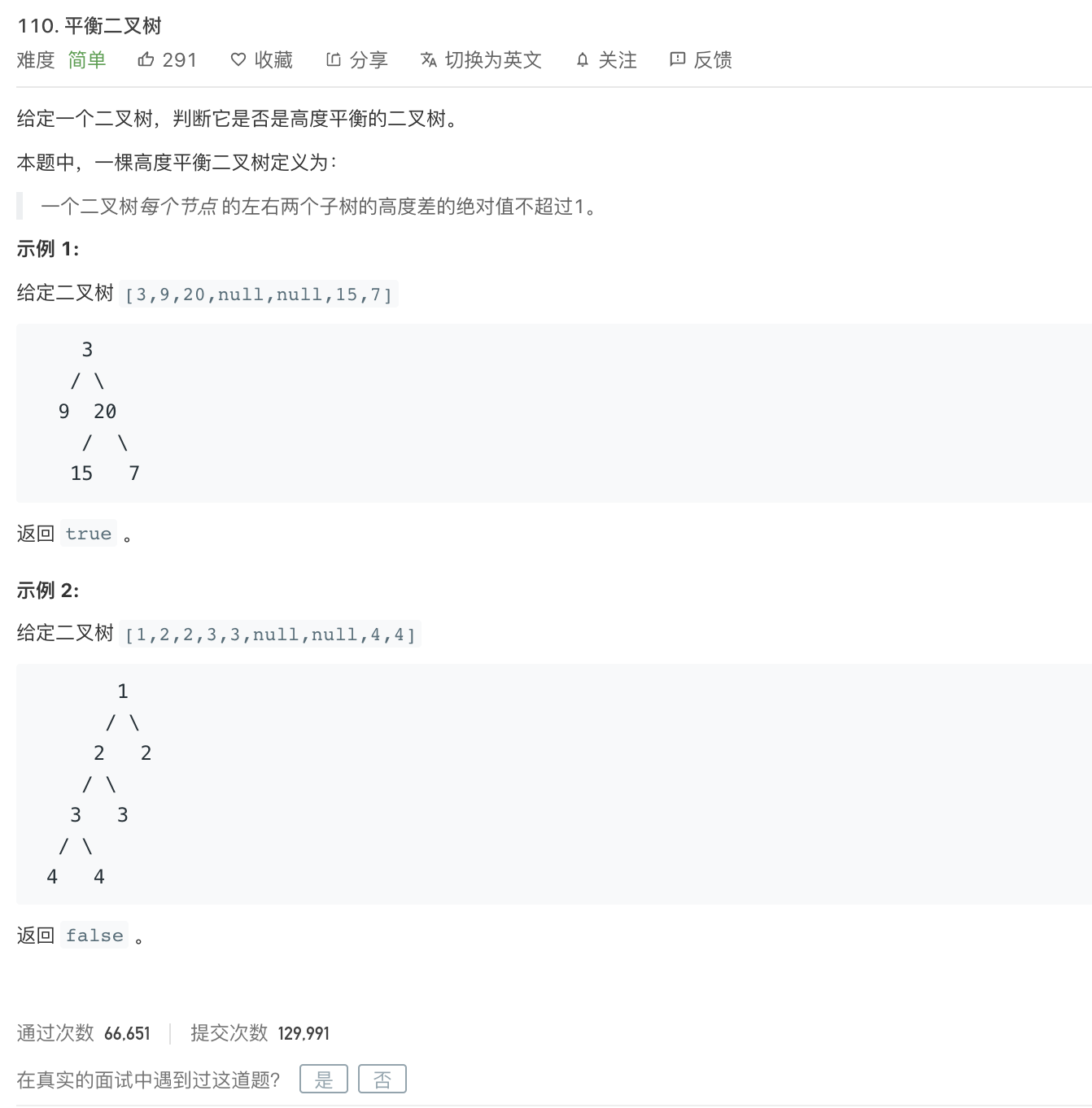
110. 平衡二叉树
难度: 简单
1
2
3
4
5
6
7
8
9
10
11
12
13
14
15
16
17
18
19
20
21
22
23
24
25
26
27
28
29
30
31
32
33
34
35
36
37
38
39
40
41
42
43
44
45
46
47
48
49
50
51
52
53
54
55
56
57
|
package main

import "fmt"

type TreeNode struct {
	Val   int
	Left  *TreeNode
	Right *TreeNode
}

func main() {

	root := TreeNode{
		Val:   3,
		Left:  &TreeNode{Val: 9},
		Right: &TreeNode{Val: 20, Left: &TreeNode{Val: 15}, Right: &TreeNode{Val: 7}},
	}

	rs := isBalanced(&root)

	fmt.Println(rs)

}

func isBalanced(root *TreeNode) bool {

	if root == nil {
		return true
	}

	fmt.Println(111)

	if isBalanced(root.Left) && isBalanced(root.Right) && height(root.Left)-height(root.Right) <= 1 && height(root.Left)-height(root.Right) >= -1 {
		return true
	} else {
		return false
	}
}

func height(root *TreeNode) int {
	var h int

	if root == nil {
		return h
	}

	fmt.Println("左右为:", height(root.Left), height(root.Right))

	if height(root.Left) >= height(root.Right) {

		return height(root.Left) + 1
	} else {
		return height(root.Right) + 1
	}
}
|
Go Math中很多常用方法的返回值都是float..比如取绝对值,取最大值
三道题套路解决递归问题
如链接失效,可点击
原文链接: https://dashen.tech/2015/03/01/leetcode-110-平衡二叉树/
版权声明: 转载请注明出处.