1
2
3
4
5
6
7
8
9
10
11
12
13
14
15
16
17
18
19
20
21
22
23
24
25
26
27
28
29
30
31
32
33
34
35
36
37
38
39
40
41
42
43
44
45
46
47
48
49
50
51
52
53
54
55
56
57
58
59
60
61
62
63
64
65
66
67
68
69
70
71
72
73
74
75
76
77
78
79
80
81
82
83
84
85
86
87
88
89
90
91
92
93
94
95
96
97
98
99
100
101
102
103
104
105
106
107
108
109
110
111
112
113
114
115
116
117
118
119
120
121
122
123
124
125
126
127
128
129
130
131
132
133
134
135
136
137
138
139
140
141
142
143
144
145
146
147
148
149
150
151
152
153
154
155
156
157
158
159
160
161
162
163
164
165
166
167
168
169
170
171
172
173
174
175
176
177
178
179
180
181
182
183
184
185
186
187
188
189
190
191
192
193
194
195
196
197
198
199
200
201
202
203
204
205
206
207
208
209
210
211
212
213
214
215
216
217
218
219
220
221
222
223
224
225
226
227
228
229
230
231
| Package runtime contains operations that interact with Go’s runtime system,
such as functions to control goroutines. It also includes the low-level type information
used by the reflect package; see reflect’s documentation for the programmable
interface to the run-time type system.
# Environment Variables
The following environment variables ($name or %name%, depending on the host
operating system) control the run-time behavior of Go programs. The meanings
and use may change from release to release.
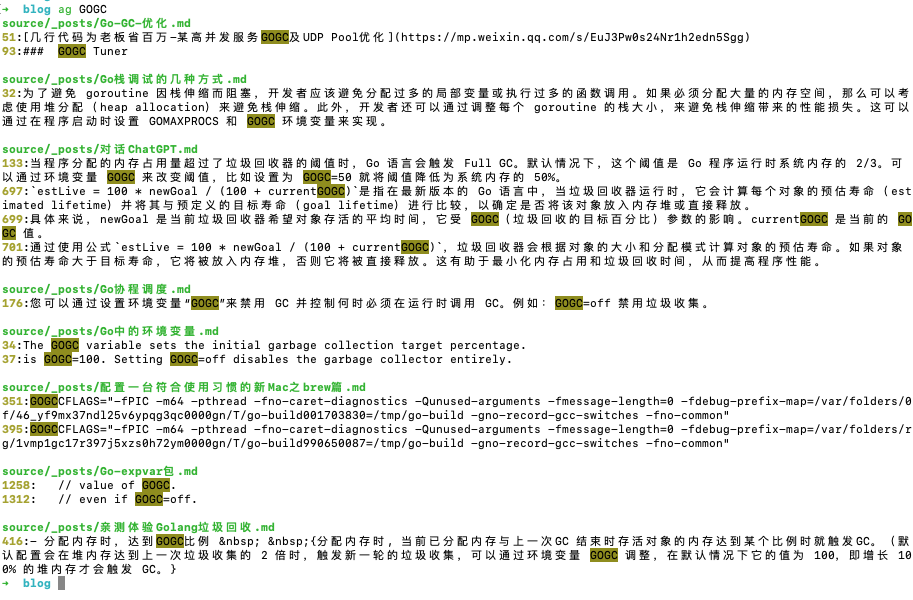
The GOGC variable sets the initial garbage collection target percentage.
A collection is triggered when the ratio of freshly allocated data to live data
remaining after the previous collection reaches this percentage. The default
is GOGC=100. Setting GOGC=off disables the garbage collector entirely.
[runtime/debug.SetGCPercent] allows changing this percentage at run time.
The GOMEMLIMIT variable sets a soft memory limit for the runtime. This memory limit
includes the Go heap and all other memory managed by the runtime, and excludes
external memory sources such as mappings of the binary itself, memory managed in
other languages, and memory held by the operating system on behalf of the Go
program. GOMEMLIMIT is a numeric value in bytes with an optional unit suffix.
The supported suffixes include B, KiB, MiB, GiB, and TiB. These suffixes
represent quantities of bytes as defined by the IEC 80000-13 standard. That is,
they are based on powers of two: KiB means 2^10 bytes, MiB means 2^20 bytes,
and so on. The default setting is math.MaxInt64, which effectively disables the
memory limit. [runtime/debug.SetMemoryLimit] allows changing this limit at run
time.
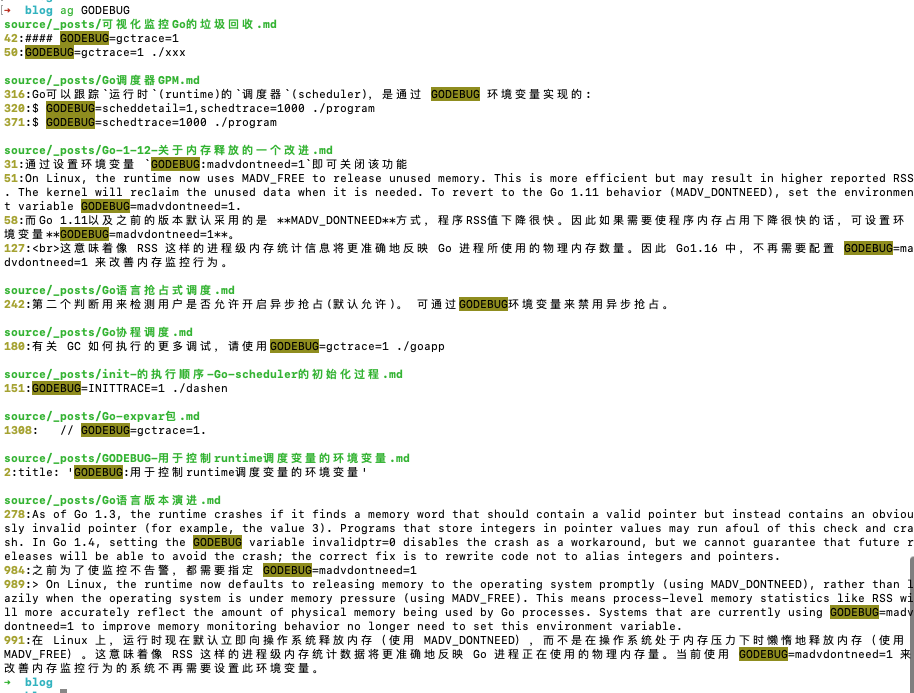
The GODEBUG variable controls debugging variables within the runtime.
It is a comma-separated list of name=val pairs setting these named variables:
allocfreetrace: setting allocfreetrace=1 causes every allocation to be
profiled and a stack trace printed on each object’s allocation and free.
clobberfree: setting clobberfree=1 causes the garbage collector to
clobber the memory content of an object with bad content when it frees
the object.
cpu.*: cpu.all=off disables the use of all optional instruction set extensions.
cpu.extension=off disables use of instructions from the specified instruction set extension.
extension is the lower case name for the instruction set extension such as sse41 or avx
as listed in internal/cpu package. As an example cpu.avx=off disables runtime detection
and thereby use of AVX instructions.
cgocheck: setting cgocheck=0 disables all checks for packages
using cgo to incorrectly pass Go pointers to non-Go code.
Setting cgocheck=1 (the default) enables relatively cheap
checks that may miss some errors. A more complete, but slow,
cgocheck mode can be enabled using GOEXPERIMENT (which
requires a rebuild), see https:
dontfreezetheworld: by default, the start of a fatal panic or throw
"freezes the world", preempting all threads to stop all running
goroutines, which makes it possible to traceback all goroutines, and
keeps their state close to the point of panic. Setting
dontfreezetheworld=1 disables this preemption, allowing goroutines to
continue executing during panic processing. Note that goroutines that
naturally enter the scheduler will still stop. This can be useful when
debugging the runtime scheduler, as freezetheworld perturbs scheduler
state and thus may hide problems.
efence: setting efence=1 causes the allocator to run in a mode
where each object is allocated on a unique page and addresses are
never recycled.
gccheckmark: setting gccheckmark=1 enables verification of the
garbage collector’s concurrent mark phase by performing a
second mark pass while the world is stopped. If the second
pass finds a reachable object that was not found by concurrent
mark, the garbage collector will panic.
gcpacertrace: setting gcpacertrace=1 causes the garbage collector to
print information about the internal state of the concurrent pacer.
gcshrinkstackoff: setting gcshrinkstackoff=1 disables moving goroutines
onto smaller stacks. In this mode, a goroutine’s stack can only grow.
gcstoptheworld: setting gcstoptheworld=1 disables concurrent garbage collection,
making every garbage collection a stop-the-world event. Setting gcstoptheworld=2
also disables concurrent sweeping after the garbage collection finishes.
gctrace: setting gctrace=1 causes the garbage collector to emit a single line to standard
error at each collection, summarizing the amount of memory collected and the
length of the pause. The format of this line is subject to change.
Currently, it is:
gc # @#s #%: #+#+# ms clock, #+#/#/#+# ms cpu, #->#-># MB, # MB goal, # MB stacks, #MB globals, # P
where the fields are as follows:
gc # the GC number, incremented at each GC
@#s time in seconds since program start
#% percentage of time spent in GC since program start
#+...+# wall-clock/CPU times for the phases of the GC
#->#-># MB heap size at GC start, at GC end, and live heap
# MB goal goal heap size
# MB stacks estimated scannable stack size
# MB globals scannable global size
# P number of processors used
The phases are stop-the-world (STW) sweep termination, concurrent
mark and scan, and STW mark termination. The CPU times
for mark/scan are broken down in to assist time (GC performed in
line with allocation), background GC time, and idle GC time.
If the line ends with "(forced)", this GC was forced by a
runtime.GC() call.
harddecommit: setting harddecommit=1 causes memory that is returned to the OS to
also have protections removed on it. This is the only mode of operation on Windows,
but is helpful in debugging scavenger-related issues on other platforms. Currently,
only supported on Linux.
inittrace: setting inittrace=1 causes the runtime to emit a single line to standard
error for each package with init work, summarizing the execution time and memory
allocation. No information is printed for inits executed as part of plugin loading
and for packages without both user defined and compiler generated init work.
The format of this line is subject to change. Currently, it is:
init # @#ms, # ms clock, # bytes, # allocs
where the fields are as follows:
init # the package name
@# ms time in milliseconds when the init started since program start
# clock wall-clock time for package initialization work
# bytes memory allocated on the heap
# allocs number of heap allocations
madvdontneed: setting madvdontneed=0 will use MADV_FREE
instead of MADV_DONTNEED on Linux when returning memory to the
kernel. This is more efficient, but means RSS numbers will
drop only when the OS is under memory pressure. On the BSDs and
Illumos/Solaris, setting madvdontneed=1 will use MADV_DONTNEED instead
of MADV_FREE. This is less efficient, but causes RSS numbers to drop
more quickly.
memprofilerate: setting memprofilerate=X will update the value of runtime.MemProfileRate.
When set to 0 memory profiling is disabled. Refer to the description of
MemProfileRate for the default value.
pagetrace: setting pagetrace=/path/to/file will write out a trace of page events
that can be viewed, analyzed, and visualized using the x/debug/cmd/pagetrace tool.
Build your program with GOEXPERIMENT=pagetrace to enable this functionality. Do not
enable this functionality if your program is a setuid binary as it introduces a security
risk in that scenario. Currently not supported on Windows, plan9 or js/wasm. Setting this
option for some applications can produce large traces, so use with care.
invalidptr: invalidptr=1 (the default) causes the garbage collector and stack
copier to crash the program if an invalid pointer value (for example, 1)
is found in a pointer-typed location. Setting invalidptr=0 disables this check.
This should only be used as a temporary workaround to diagnose buggy code.
The real fix is to not store integers in pointer-typed locations.
sbrk: setting sbrk=1 replaces the memory allocator and garbage collector
with a trivial allocator that obtains memory from the operating system and
never reclaims any memory.
scavtrace: setting scavtrace=1 causes the runtime to emit a single line to standard
error, roughly once per GC cycle, summarizing the amount of work done by the
scavenger as well as the total amount of memory returned to the operating system
and an estimate of physical memory utilization. The format of this line is subject
to change, but currently it is:
scav # KiB work (bg), # KiB work (eager), # KiB total, #% util
where the fields are as follows:
# KiB work (bg) the amount of memory returned to the OS in the background since
the last line
# KiB work (eager) the amount of memory returned to the OS eagerly since the last line
# KiB now the amount of address space currently returned to the OS
#% util the fraction of all unscavenged heap memory which is in-use
If the line ends with "(forced)", then scavenging was forced by a
debug.FreeOSMemory() call.
scheddetail: setting schedtrace=X and scheddetail=1 causes the scheduler to emit
detailed multiline info every X milliseconds, describing state of the scheduler,
processors, threads and goroutines.
schedtrace: setting schedtrace=X causes the scheduler to emit a single line to standard
error every X milliseconds, summarizing the scheduler state.
tracebackancestors: setting tracebackancestors=N extends tracebacks with the stacks at
which goroutines were created, where N limits the number of ancestor goroutines to
report. This also extends the information returned by runtime.Stack. Ancestor’s goroutine
IDs will refer to the ID of the goroutine at the time of creation; it’s possible for this
ID to be reused for another goroutine. Setting N to 0 will report no ancestry information.
tracefpunwindoff: setting tracefpunwindoff=1 forces the execution tracer to
use the runtime’s default stack unwinder instead of frame pointer unwinding.
This increases tracer overhead, but could be helpful as a workaround or for
debugging unexpected regressions caused by frame pointer unwinding.
asyncpreemptoff: asyncpreemptoff=1 disables signal-based
asynchronous goroutine preemption. This makes some loops
non-preemptible for long periods, which may delay GC and
goroutine scheduling. This is useful for debugging GC issues
because it also disables the conservative stack scanning used
for asynchronously preempted goroutines.
The net and net/http packages also refer to debugging variables in GODEBUG.
See the documentation for those packages for details.
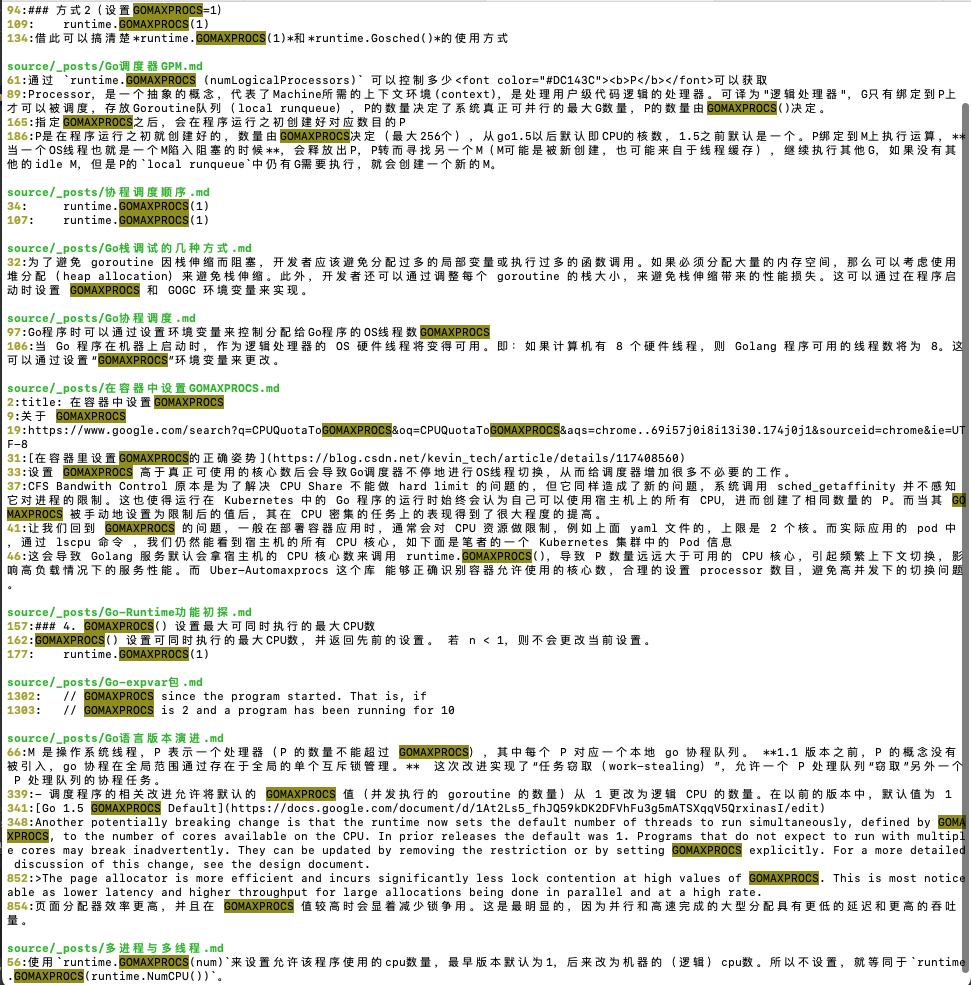
The GOMAXPROCS variable limits the number of operating system threads that
can execute user-level Go code simultaneously. There is no limit to the number of threads
that can be blocked in system calls on behalf of Go code; those do not count against
the GOMAXPROCS limit. This package‘s GOMAXPROCS function queries and changes
the limit.
The GORACE variable configures the race detector, for programs built using -race.
See https:
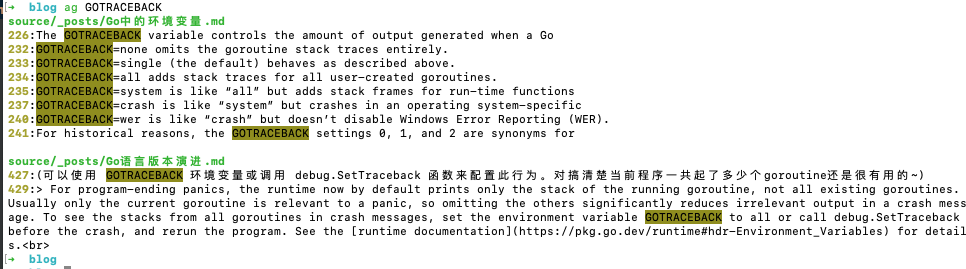
The GOTRACEBACK variable controls the amount of output generated when a Go
program fails due to an unrecovered panic or an unexpected runtime condition.
By default, a failure prints a stack trace for the current goroutine,
eliding functions internal to the run-time system, and then exits with exit code 2.
The failure prints stack traces for all goroutines if there is no current goroutine
or the failure is internal to the run-time.
GOTRACEBACK=none omits the goroutine stack traces entirely.
GOTRACEBACK=single (the default) behaves as described above.
GOTRACEBACK=all adds stack traces for all user-created goroutines.
GOTRACEBACK=system is like “all” but adds stack frames for run-time functions
and shows goroutines created internally by the run-time.
GOTRACEBACK=crash is like “system” but crashes in an operating system-specific
manner instead of exiting. For example, on Unix systems, the crash raises
SIGABRT to trigger a core dump.
GOTRACEBACK=wer is like “crash” but doesn’t disable Windows Error Reporting (WER).
For historical reasons, the GOTRACEBACK settings 0, 1, and 2 are synonyms for
none, all, and system, respectively.
The runtime/debug package’s SetTraceback function allows increasing the
amount of output at run time, but it cannot reduce the amount below that
specified by the environment variable.
See https:
The GOARCH, GOOS, GOPATH, and GOROOT environment variables complete
the set of Go environment variables. They influence the building of Go programs
(see https:
GOARCH, GOOS, and GOROOT are recorded at compile time and made available by
constants or functions in this package, but they do not influence the execution
of the run-time system.
|