math.Sqrt源码分析

1
2
3
4
5
6
7
8
9
10
11
12
13
14
15
16
17
18
19
20
21
22
23
24
25
26
27
28
29
30
31
32
33
34
35
36
37
38
39
40
41
42
43
44
45
46
47
48
49
50
51
52
53
54
55
56
57
58
59
60
61
62
63
64
65
66
67
68
69
70
71
72
73
74
75
76
77
78
79
80
81
82
83
84
85
86
87
88
89
90
91
92
93
94
95
96
97
98
99
100
101
102
103
104
105
106
107
108
109
110
111
112
113
114
115
116
117
118
119
120
121
122
123
124
125
126
127
128
129
130
131
132
133
134
135
136
137
138
139
140
141
142
143
144
145
146
147

// Copyright 2009 The Go Authors. All rights reserved.
// Use of this source code is governed by a BSD-style
// license that can be found in the LICENSE file.

package math

// The original C code and the long comment below are
// from FreeBSD's /usr/src/lib/msun/src/e_sqrt.c and
// came with this notice. The go code is a simplified
// version of the original C.
//
// ====================================================
// Copyright (C) 1993 by Sun Microsystems, Inc. All rights reserved.
//
// Developed at SunPro, a Sun Microsystems, Inc. business.
// Permission to use, copy, modify, and distribute this
// software is freely granted, provided that this notice
// is preserved.
// ====================================================
//
// __ieee754_sqrt(x)
// Return correctly rounded sqrt.
// -----------------------------------------
// | Use the hardware sqrt if you have one |
// -----------------------------------------
// Method:
// Bit by bit method using integer arithmetic. (Slow, but portable)
// 1. Normalization
// Scale x to y in [1,4) with even powers of 2:
// find an integer k such that 1 <= (y=x*2**(2k)) < 4, then
// sqrt(x) = 2**k * sqrt(y)
// 2. Bit by bit computation
// Let q = sqrt(y) truncated to i bit after binary point (q = 1),
// i 0
// i+1 2
// s = 2*q , and y = 2 * ( y - q ). (1)
// i i i i
//
// To compute q from q , one checks whether
// i+1 i
//
// -(i+1) 2
// (q + 2 ) <= y. (2)
// i
// -(i+1)
// If (2) is false, then q = q ; otherwise q = q + 2 .
// i+1 i i+1 i
//
// With some algebraic manipulation, it is not difficult to see
// that (2) is equivalent to
// -(i+1)
// s + 2 <= y (3)
// i i
//
// The advantage of (3) is that s and y can be computed by
// i i
// the following recurrence formula:
// if (3) is false
//
// s = s , y = y ; (4)
// i+1 i i+1 i
//
// otherwise,
// -i -(i+1)
// s = s + 2 , y = y - s - 2 (5)
// i+1 i i+1 i i
//
// One may easily use induction to prove (4) and (5).
// Note. Since the left hand side of (3) contain only i+2 bits,
// it does not necessary to do a full (53-bit) comparison
// in (3).
// 3. Final rounding
// After generating the 53 bits result, we compute one more bit.
// Together with the remainder, we can decide whether the
// result is exact, bigger than 1/2ulp, or less than 1/2ulp
// (it will never equal to 1/2ulp).
// The rounding mode can be detected by checking whether
// huge + tiny is equal to huge, and whether huge - tiny is
// equal to huge for some floating point number "huge" and "tiny".
//
//
// Notes: Rounding mode detection omitted. The constants "mask", "shift",
// and "bias" are found in src/math/bits.go

// Sqrt returns the square root of x.
//
// Special cases are:
// Sqrt(+Inf) = +Inf
// Sqrt(±0) = ±0
// Sqrt(x < 0) = NaN
// Sqrt(NaN) = NaN
func Sqrt(x float64) float64

// Note: Sqrt is implemented in assembly on some systems.
// Others have assembly stubs that jump to func sqrt below.
// On systems where Sqrt is a single instruction, the compiler
// may turn a direct call into a direct use of that instruction instead.

func sqrt(x float64) float64 {
// special cases
switch {
case x == 0 || IsNaN(x) || IsInf(x, 1):
return x
case x < 0:
return NaN()
}
ix := Float64bits(x)
// normalize x
exp := int((ix >> shift) & mask)
if exp == 0 { // subnormal x
for ix&(1<<shift) == 0 {
ix <<= 1
exp--
}
exp++
}
exp -= bias // unbias exponent
ix &^= mask << shift
ix |= 1 << shift
if exp&1 == 1 { // odd exp, double x to make it even
ix <<= 1
}
exp >>= 1 // exp = exp/2, exponent of square root
// generate sqrt(x) bit by bit
ix <<= 1
var q, s uint64 // q = sqrt(x)
r := uint64(1 << (shift + 1)) // r = moving bit from MSB to LSB
for r != 0 {
t := s + r
if t <= ix {
s = t + r
ix -= t
q += r
}
ix <<= 1
r >>= 1
}
// final rounding
if ix != 0 { // remainder, result not exact
q += q & 1 // round according to extra bit
}
ix = q>>1 + uint64(exp-1+bias)<<shift // significand + biased exponent
return Float64frombits(ix)
}


IEEE二进制浮点数算术标准(IEEE 754)

Leetcode中几道二分查找(Binary Search)的算法题总结

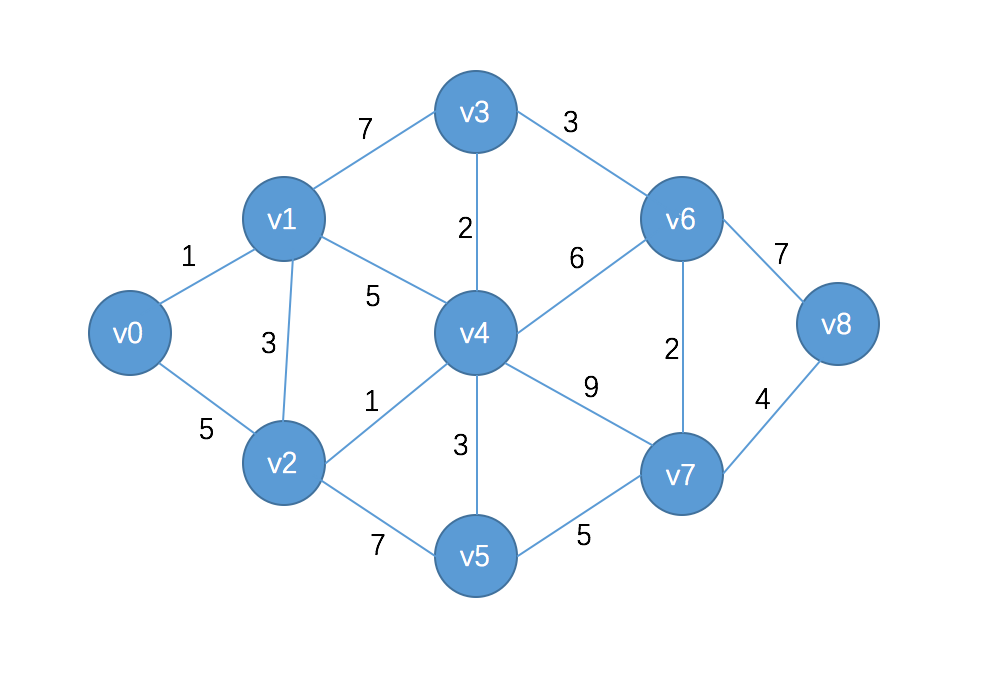
Prim算法

中文一般译作普里姆算法

该算法于1930年由捷克数学家沃伊捷赫·亚尔尼克发现;并在1957年由美国计算机科学家罗伯特·普里姆(Robert C. Prim,1921年出生于美国德州)独立发现;1959年,艾兹格·迪科斯彻再次发现了该算法。因此,在某些场合,普里姆算法又被称为DJP算法.

有些类似迪杰克斯拉算法

Floyd算法

上篇的Dijkstra算法,可以求某个确定的起始点到其他任何点的最短路径.但当需要计算任意两点间的最短距离时,Dijkstra算法就需要改变起点多次计算

而利用Floyd算法,可以求任意两个顶点之间的最短路径

形式非常简单,三层循环,故而也被谐称为”3f算法”,时间复杂度为O(n³)
K8s创建包含多个容器的Pod

K8s的调度单位是pod,有独立的网卡。

一个pod里面可以有一到多个container,当需要部署多个进程时,非常有用。

比如现在有一个应用程序进程,一个用于监控其网络流量用于回放的goreply进程 gor,

K8s排错&调试技巧
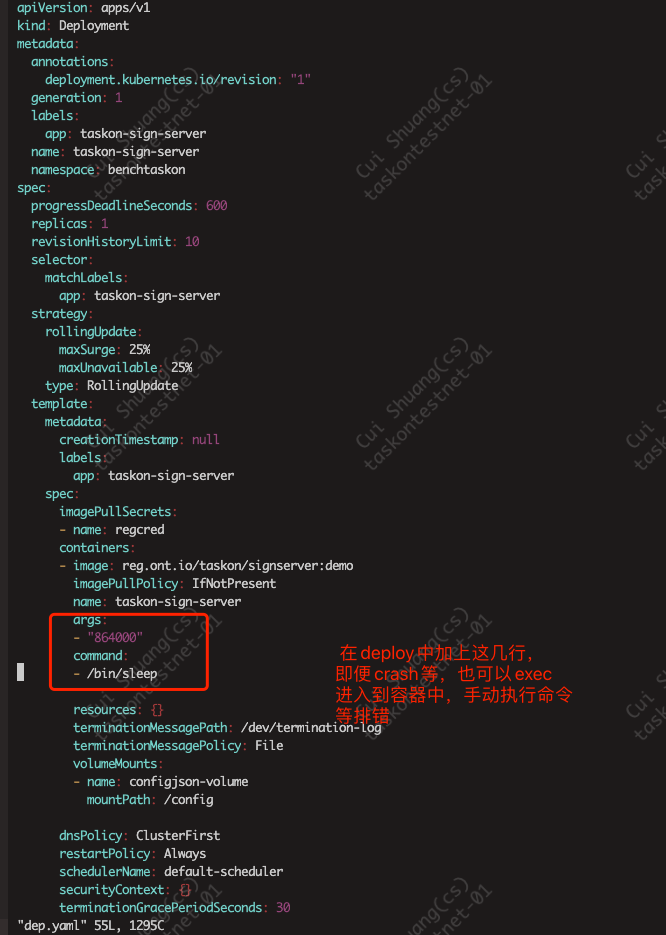
此时进入到pod中,ps aux会看到sleep 86400的进程

注意,这样会一定只执行 sleep 86400,真正的应用程序无法得到执行。仅用于进入pod调试,如果容器中ps aux发现服务能正产运行了,需要将这几行注释掉,重新apply deploy.yaml